PVDF vs PES Filters: A Researcher's Selection Guide
Discover how to choose between PVDF and PES filters for your specific applications. Optimize results in your lab with this expert guide!
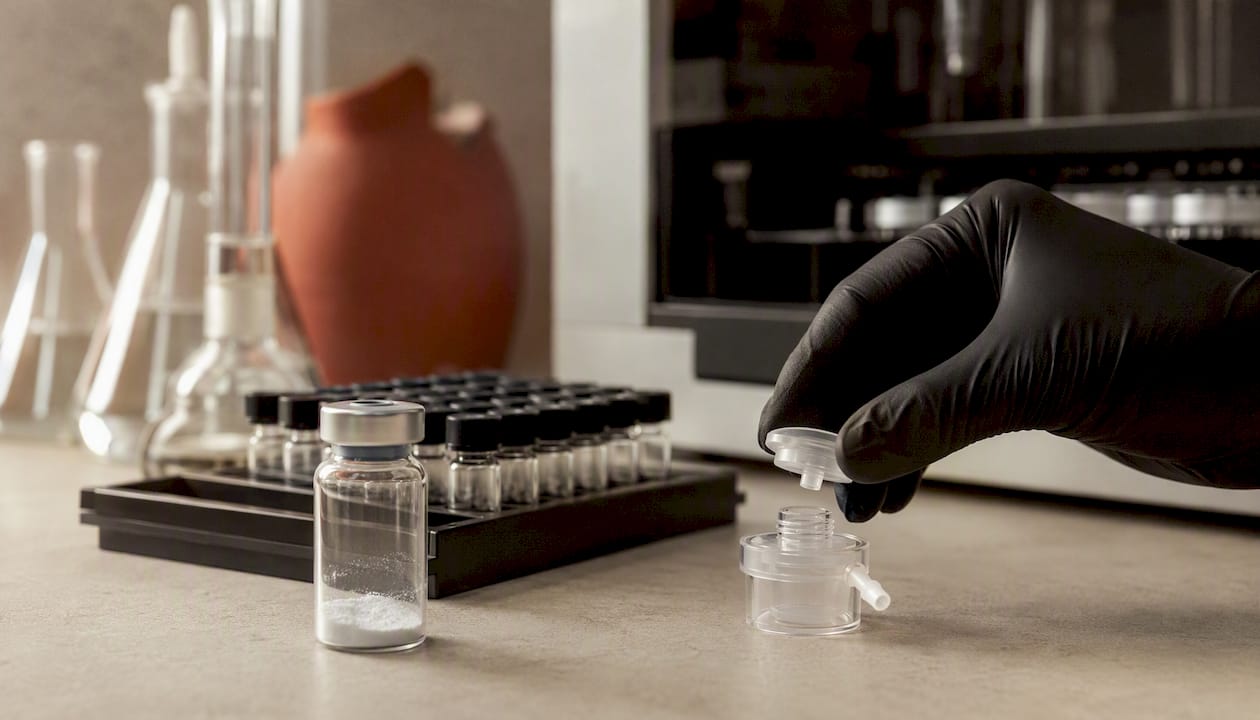
For aqueous, protein-containing solutions like cell culture media or serum, default to a PES (polyethersulfone) membrane. For solvents, aggressive chemicals, or HPLC mobile-phase prep, default to PVDF (polyvinylidene fluoride). That single distinction resolves most membrane decisions on the bench.
Pore size follows a separate logic: 0.22 µm is the accepted standard for sterile filtration, 0.45 µm handles clarification and particulate removal, and 0.1 µm is reserved for mycoplasma-risk work. Get the chemistry right first, then match the pore size to the task.
A few defaults for common jobs:
- Sterile cell culture media: PES, 0.22 µm
- Fetal bovine serum (FBS): PES, 0.22 µm (low protein binding preserves growth factor concentrations)
- HPLC sample prep in organic solvent: PVDF, 0.22 µm or 0.45 µm depending on particulate load
- DMSO-based solutions or aggressive reagent mixes: PVDF, verify pore size against downstream assay tolerance
- Air vents on bioreactors or flasks: hydrophobic PVDF or PTFE, 0.22 µm
The rest of this guide breaks down why those defaults hold up, where they don’t, and what to check on a datasheet before you trust a membrane with an irreplaceable sample.
Key Takeaways
Choosing between PES and PVDF comes down to sample chemistry first, pore size second, and datasheet verification always.
| Point | Details |
|---|---|
| Default to PES for biological work | Use PES for sterile media, serum, and any protein-rich aqueous solution to minimize protein loss. |
| Default to PVDF for solvents | Use PVDF for DMSO, alcohols, ketones, and other organic solvent systems where PES would degrade. |
| Match pore size to purpose | Choose 0.22 µm for sterility, 0.45 µm for clarification, and 0.1 µm only for mycoplasma-risk work. |
| Pre-wet hydrophobic PVDF correctly | Pass a low-surface-tension solvent through first, then rinse with sterile water before filtering aqueous samples. |
| Archive COA and integrity data | Keep lot number, bubble-point results, and sterilization method with your experiment records for traceability. |
Table of Contents
- PVDF vs PES Filters: What the Polymer Chemistry Actually Determines
- Does PES or PVDF Bind More Protein?
- Which Solvents Require PVDF Instead of PES?
- Thermal and Mechanical Limits You Need to Know
- 0.22 µm vs 0.45 µm: Which Pore Size Do You Actually Need?
- Matching Membrane and Pore Size to Common Lab Tasks
- Pre-Wetting, Storage, and What to Check Before You Filter
- What Drives the Cost of PES and PVDF Filters?
- PES vs PVDF Filters at a Glance
- How Do You Verify a Membrane’s Quality Before You Trust It?
- Sources
PVDF vs PES Filters: What the Polymer Chemistry Actually Determines
The performance gap between these two membranes traces directly back to their polymer backbones. PES is built from repeating aryl-sulfone units linked by ether bonds, a structure that’s inherently polar and readily wets with water. That polarity is why PES membranes ship hydrophilic out of the box, with no pre-wetting step required for aqueous work.
PVDF’s backbone is a fluoropolymer chain, chemically related to PTFE but not nearly as inert. The carbon-fluorine bonds give PVDF its signature resistance to organic solvents and oxidizing agents, along with better thermal and mechanical durability. But that same fluorinated structure makes the base polymer hydrophobic, which is why manufacturers either treat it with a hydrophilic surface coating or leave it hydrophobic for gas venting and solvent applications.
Pore architecture matters just as much as chemistry:
- PES membranes are typically cast with an asymmetric, graded pore structure, wide at the entry point and progressively finer toward the exit. This geometry reduces resistance and drives the faster flow rates PES is known for, particularly useful when you’re pushing large volumes of media through a bottle-top unit.
- PVDF membranes tend toward a more uniform, isotropic pore structure, which trades some throughput speed for mechanical consistency and lower extractable content in solvent systems, a point Membrane Solutions highlights in its technical comparison of PVDF properties.
- Extractables matter more than most researchers assume: a membrane that sheds trace polymer residue into an HPLC sample can show up as a ghost peak days later, and PVDF’s lower extractable profile in many solvent systems is part of why it’s the analytical prep default.
Does PES or PVDF Bind More Protein?
Standard PES is inherently hydrophilic and exhibits very low protein binding for many common serum proteins, which is why it’s the default membrane for anything protein-rich. That low-binding profile isn’t universal across every protein, though. Binding is sequence and charge dependent, so a membrane that barely touches bovine serum albumin might behave differently with a low-abundance cytokine.
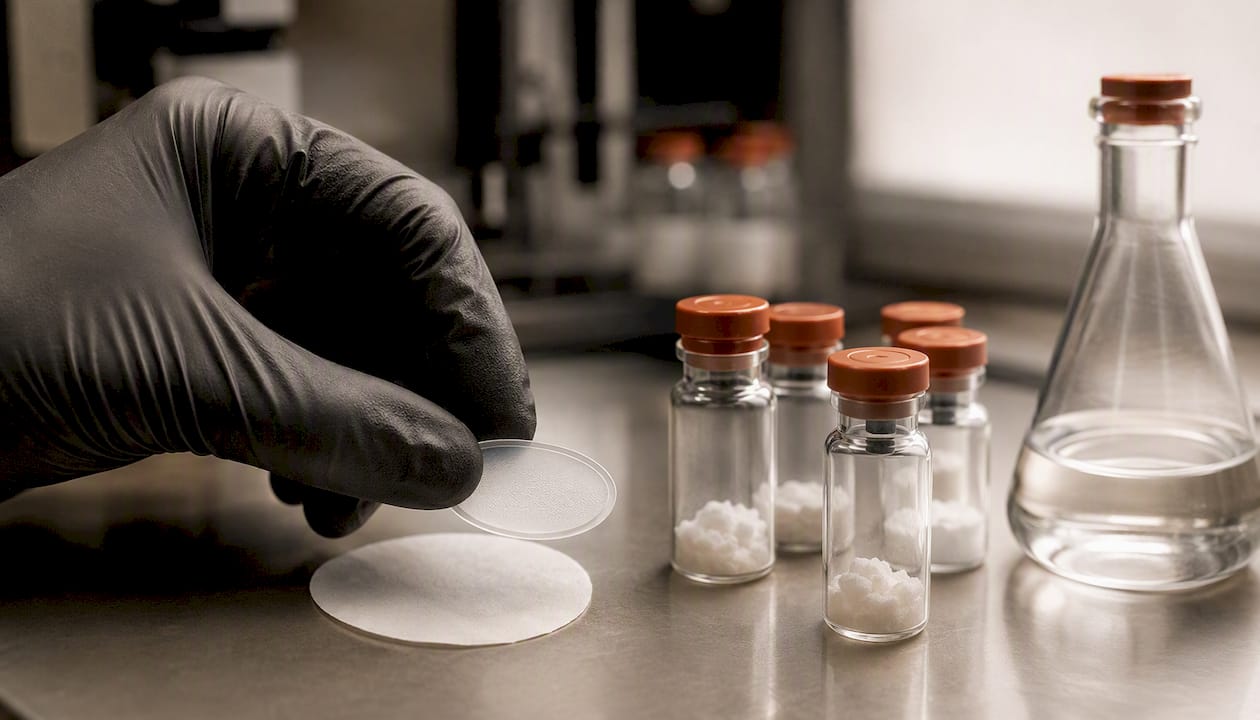
PVDF splits into two camps. Hydrophobic PVDF requires pre-wetting before it will pass an aqueous solution at all, and even after wetting, it tends to adsorb more protein than PES. Hydrophilic-treated PVDF narrows that gap but still generally runs higher on protein binding than PES in side-by-side comparisons, according to filtration guidance from Innovative Bioscience.
Here’s the practical risk: if you’re filtering a dilute growth factor solution and the membrane adsorbs even a few percent of the target protein, your downstream assay reads artificially low. You won’t necessarily know the membrane caused it unless you’ve run a recovery check.
Pro Tip: If you’re filtering a low-abundance protein or growth factor solution, pre-rinse the membrane with a small volume of your own buffer before pushing the actual sample through. This saturates non-specific binding sites so your real sample doesn’t take the hit.
Practical steps that reduce protein loss:
- Default to PES for any serum, cytokine, growth factor, or antibody-containing solution.
- Reserve hydrophilic PVDF for cases where chemical compatibility overrides the protein-binding concern.
- Never assume “low protein binding” on a spec sheet applies equally to every protein in your assay. Verify with a recovery test if the concentration is critical.
Which Solvents Require PVDF Instead of PES?
PES handles aqueous buffers well but degrades or swells in many organic solvents, which rules it out for most solvent-heavy prep work. PVDF is the standard choice for:
- Alcohols (methanol, ethanol, isopropanol)
- Many ketones, including acetone in moderate concentrations
- DMSO-based solutions, common in stock compound prep
- Most other organic solvents used in HPLC mobile-phase filtration
- Strong acids and bases, within manufacturer-specified concentration limits
There’s an important exception. For especially aggressive solvent systems, chlorinated solvents at high concentration or certain strong oxidizers, even PVDF isn’t universally inert, and PTFE becomes the safer choice. PVDF is broadly resistant, not bulletproof, and treating it as a universal solvent-proof membrane is a mistake that shows up as membrane swelling or leaching weeks into a study.
Always cross-check the exact solvent, concentration, and temperature against the manufacturer’s chemical compatibility chart before committing an irreplaceable sample to a filtration run. Compatibility data is formulation-specific. A PVDF membrane from one manufacturer isn’t guaranteed to behave identically to another vendor’s PVDF at the same nominal pore size.
One more procedural note: hydrophobic PVDF needs to be pre-wet with a low-surface-tension solvent, methanol or ethanol are common choices, before it will pass an aqueous solution. Skip that step and you’ll get poor flow or outright filter failure, not a chemistry problem but a wetting problem.
Thermal and Mechanical Limits You Need to Know
PVDF generally tolerates higher temperatures and higher differential pressure than PES, which is part of why it shows up more often in industrial and high-throughput solvent applications, though specifications vary between products. That said, “generally higher” isn’t a substitute for checking the actual spec sheet. Thermal and pressure ratings vary between manufacturers and even between product lines from the same manufacturer, so treat published comparisons as a starting point, not a final answer.
A structural and performance study of PES and PVDF membranes exposed to treated feed water found measurable differences in fouling behavior and structural degradation over time between the two chemistries, a reminder that real-world exposure conditions, not just headline thermal ratings, determine how a membrane holds up across repeated use.
Format matters as much as polymer chemistry when it comes to mechanical robustness:
- Supported or backed membranes resist tearing far better than unsupported films, especially under vacuum filtration where pressure differentials stress the membrane surface.
- Cartridge housings protect the membrane from handling damage during high-volume or repeated filtration runs.
- Syringe filters are convenient for small volumes but more prone to rupture if you force plunger pressure against a partially clogged membrane.
Pro Tip: If you’re running vacuum filtration on a bottle-top unit, never exceed the vacuum rating printed on the housing. A cracked housing under vacuum wastes the sample and can contaminate whatever’s downstream in your setup.
0.22 µm vs 0.45 µm: Which Pore Size Do You Actually Need?
Pore size selection follows three clear rules for most laboratory work.
- Use 0.22 µm when sterility is the goal. This is the accepted industry standard for sterile filtration of cell culture media, buffers, and any solution that needs to be rendered free of bacteria before use.
- Use 0.45 µm when clarification, not sterility, is the objective. Removing particulates from a solvent, pre-filtering a turbid sample before HPLC injection, or clarifying a buffer before a downstream 0.22 µm sterile step are all appropriate 0.45 µm applications.
- Reserve 0.1 µm for mycoplasma-risk situations. Standard 0.22 µm membranes don’t reliably exclude mycoplasma, so cell culture work with known or suspected mycoplasma contamination risk calls for the tighter pore size.
Switching to 0.22 µm by default, even when your method doesn’t require sterility, carries real downstream costs. A tighter pore size means higher back-pressure, slower flow, and a membrane that clogs faster if your sample carries any particulate load. If a solution is turbid or contains precipitate, pre-filter through 0.45 µm first, then finish with 0.22 µm if sterility is actually required. That two-step approach protects the finer, more expensive membrane from premature clogging and saves you from re-running a filtration because the first pass never finished dripping.
Matching Membrane and Pore Size to Common Lab Tasks
The chemistry-first, pore-size-second logic plays out differently across routine lab workflows. Here’s how it maps in practice.
Format should track sample volume and sterility requirements. Syringe filters work well for small analytical volumes under 50 mL. Bottle-top filters and vacuum cups handle larger media preps efficiently. Cartridge formats make sense for high-throughput or repeated filtration cycles where changing a syringe filter every few hundred milliliters isn’t practical. As vendor application notes on PES vs PVDF membrane selection point out, matching format to volume avoids both wasted membrane area and unnecessary back-pressure.
The exceptions worth flagging: if your solvent system is aggressive enough to threaten even PVDF, look at PTFE instead. And if you’re running a solution with heavy particulate load through a fine sterile membrane, the two-step pre-filter approach described above will save you time and membrane cost.
Pre-Wetting, Storage, and What to Check Before You Filter
Hydrophobic PVDF won’t pass water until it’s wetted. The standard sequence is straightforward: pass a small volume of a low-surface-tension solvent, methanol or ethanol, through the membrane first, then follow with a sterile water rinse to clear residual solvent before introducing your actual aqueous sample. Skipping the rinse step risks trace solvent carryover into a sensitive assay.
Beyond wetting protocol, a handful of datasheet and Certificate of Analysis items deserve a permanent place in your experiment records:
- Pore size and tolerance as stated by the manufacturer, not just the nominal rating.
- Lot number, tied directly to the specific membrane batch used in that experiment.
- Bubble-point or diffusion-flow integrity data, confirming the membrane met its rated pore size before shipping.
- Extractables profile, particularly relevant for solvent-based HPLC prep.
- Sterilization method used on the membrane (gamma, autoclave, or ethylene oxide), since this can affect extractables and material properties.
- Recommended operating pressure, to avoid exceeding housing or membrane tolerance.
Pro Tip: Archive the COA and lot number alongside your raw data file, not just in a separate procurement folder. When a result looks off six months later, being able to trace it back to a specific membrane lot can save days of troubleshooting.
Single-use membranes should stay single-use. Reusing a syringe filter to save cost introduces cross-contamination risk and unpredictable pore blockage that can silently shift your effective pore size mid-experiment. For high-volume clarification work, bulk cartridge formats make more economic sense than stacking single-use units.
What Drives the Cost of PES and PVDF Filters?
Format and treatment level are the two biggest cost drivers. Syringe filters are the cheapest per unit but least economical at scale. Bottle-top filters and cartridges cost more upfront but reduce per-liter cost significantly for high-volume media prep. Sterile-packaged individual units always carry a premium over bulk, non-sterile packaging, which makes sense if you’re filtering something that needs to stay sterile straight out of the wrapper.
Specialty grades push the price higher still. Hydrophilic-treated PVDF costs more than standard hydrophobic PVDF because of the additional surface treatment step. Low-extractable grades, formulated for sensitive analytical work, also carry a premium tied to tighter manufacturing controls and additional testing.
For most routine lab budgets, the sensible split is straightforward: use standard PES for everyday media filtration where cost efficiency matters and protein binding needs to stay low, and reserve specialty PVDF grades for the solvent-critical runs where the extra cost is actually buying you something, lower extractables, verified chemical compatibility, or a hydrophilic surface treatment you can’t skip.
Lead times can stretch for specialty formulations, particularly low-extractable or custom pore-size PVDF, so factor that into procurement timing if a study depends on a specific grade.
PES vs PVDF Filters at a Glance
| Property | PES | PVDF |
|---|---|---|
| Chemical resistance | Moderate; degrades in many organic solvents | Broad; resistant to alcohols, ketones, DMSO, many acids/bases |
| Hydrophilicity / wetting | Inherently hydrophilic, no pre-wetting needed | Hydrophobic (needs pre-wetting) or hydrophilic-treated variants available |
| Protein binding tendency | Low, typically well under 5 µg/cm² for many serum proteins | Higher than PES, even in hydrophilic-treated form |
| Flow rate / throughput | Fast, due to asymmetric pore structure | Moderate, more uniform pore structure |
| Thermal stability | Moderate | Generally higher; verify against specific product spec |
| Mechanical strength | Moderate; benefits from backed/supported formats | Generally higher; well suited to demanding formats |
| Typical pore sizes & common uses | 0.22 µm sterile media, 0.45 µm clarification | 0.22 µm sterile solvent filtration, 0.45 µm particulate removal |
| Sterility suitability | Standard choice for biological sterile filtration | Suitable for sterile solvent-based and analytical applications |
| Common formats | Syringe filters, bottle-top filters, cartridges | Syringe filters, discs, cartridges, vent filters |
Exact numeric values vary by manufacturer and even by lot, so treat this table as a starting framework and confirm specifics against the datasheet for the part number you’re actually ordering.
How Do You Verify a Membrane’s Quality Before You Trust It?
Two integrity tests underpin most membrane quality verification: bubble-point testing and diffusion-flow testing. Bubble-point testing measures the pressure required to force air through a wetted membrane’s largest pore, confirming the membrane meets its rated pore size specification. Diffusion-flow testing measures gas diffusion through a wetted membrane at a pressure below the bubble point, useful for larger-area membranes where bubble-point alone may not catch smaller defects. Neither test requires you to run it yourself for a purchased membrane. What matters is whether the manufacturer performed it and documented the result on the lot’s Certificate of Analysis.
Before you rely on a membrane lot for a critical experiment, confirm the following:
- The COA lists a lot number matching the physical product you received.
- Bubble-point or diffusion-flow data is present and falls within the expected range for that pore size.
- The sterilization method is documented, since it can influence extractables and material behavior.
- Extractables data is available if you’re working with solvent-based or analytical prep.
- The lot traceability chain lets you trace the membrane back to its manufacturing batch if a result needs investigation later.
Peer-reviewed literature reinforces why this matters beyond procedural box-checking. Structural and performance studies of PES and PVDF membranes have documented measurable shifts in fouling and structural characteristics after real-world exposure, meaning a membrane’s behavior in your specific application can diverge from its baseline spec sheet over time or across batches, a finding from PubMed-indexed research worth keeping in mind for any long-duration filtration protocol.
Treat COA and integrity data the same way you’d treat any other piece of experiment provenance. Store it with your raw data, not filed away separately, so that if a result needs revisiting, the membrane’s verified specifications are sitting right next to the data it helped produce. Agateresearch applies this same standard to every peptide lot it ships: independent reverse-phase HPLC purity confirmation, mass spectrometry identity verification, and a lot-specific Certificate of Analysis that travels with the product rather than sitting in a separate database. For research programs where sample integrity depends on both the filtration step and the compound purity behind it, that kind of documentation chain is the difference between a reproducible result and a mystery you can’t retrace.
Sources
- Pubmed
- PVDF Membrane Filter: Properties, Applications, and How to Choose the Right Membrane for Your Filtration Process – Membrane Solutions