Lyophilized Peptide Storage: Bench-Ready Best Practices
Learn best practices for lyophilized peptide storage to ensure maximum stability and prevent degradation, keeping your research on track.
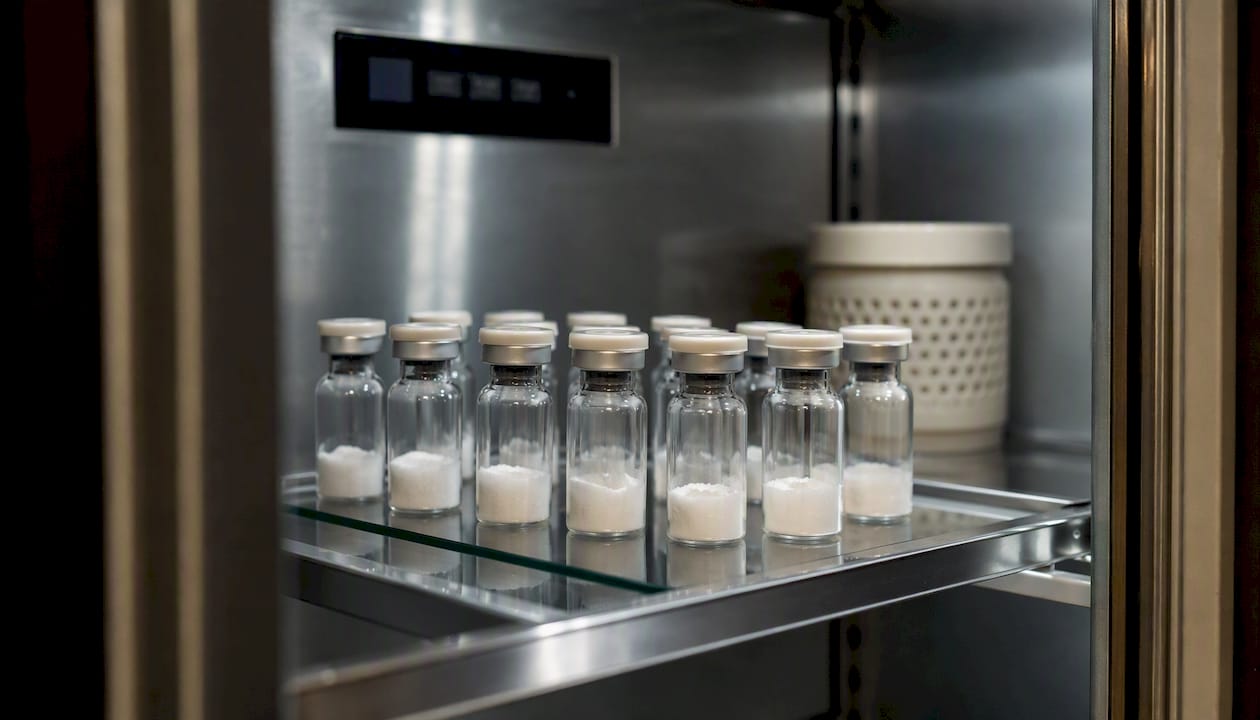
Store lyophilized peptides at -20°C for routine working stocks and at -80°C for archival lots or any sequence containing oxidation-prone or labile residues. Those two temperatures, combined with rigorous desiccation and a strict no-frost-free-freezer policy, cover the majority of dry peptide storage decisions you will face at the bench. The single highest-priority control is moisture: residual water in a lyophilized cake accelerates hydrolysis and oxidation far faster than temperature alone.
Immediate actions you can implement today:
- Store sealed vials over a desiccant (silica gel or molecular sieves) inside a secondary container before placing them in the freezer.
- Use amber or opaque vials for light-sensitive sequences (Trp, Tyr, Phe-containing peptides).
- Keep vials in a static, non-auto-defrost freezer with a calibrated temperature logger and an audible alarm.
- Never open a cold vial directly from the freezer; equilibrate in a desiccator at room temperature first.
- Aliquot reconstituted material into single-use volumes before freezing to eliminate freeze–thaw cycling.
- Sequences containing Met, Cys, Trp, or Asp-Pro/Asn-Gly motifs warrant -80°C storage and more frequent COA re-verification; see the sequence-aware guidance below.
Key Takeaways
Proper lyophilized peptide storage requires the right temperature, rigorous desiccation, a static freezer with temperature logging, and single-use aliquots after reconstitution, all anchored to a lot-specific COA.
| Point | Details |
|---|---|
| Temperature selection | Use -20°C for routine stocks; move to -80°C for archival lots or sequences with Met, Cys, Trp, Asp-Pro, or Asn-Gly. |
| Keep dry, avoid frost-free freezers | Store over desiccant in a sealed container; never use auto-defrost freezers, which introduce thermal cycling. |
| Equilibrate before opening | Warm sealed vials in a desiccator to room temperature before opening to prevent moisture condensation. |
| Aliquot after reconstitution | Divide reconstituted peptide into single-use volumes; never refreeze a thawed aliquot. |
| Agateresearch verification | Every Agateresearch lot ships with a lot-specific COA, independent HPLC chromatogram, and MS identity confirmation for full traceability. |
Table of Contents
- What are the best storage conditions for lyophilized peptides?
- How should you handle lyophilized vials before opening them?
- How to reconstitute peptides safely and store aliquots after reconstitution
- How do you recognize peptide degradation before it ruins an experiment?
- What you need to know about shipping and short-term transport
- Why lot-specific COAs and independent HPLC/MS verification matter for traceability
- The part of peptide storage most labs get wrong
- Agateresearch: research-grade peptides with lot-specific analytical verification
- Sources
What are the best storage conditions for lyophilized peptides?
The answer depends on two variables: sequence chemistry and how long you plan to keep the material. Published methodology literature converges on -20°C for routine working stocks and -80°C for archival storage, with residual moisture and thermal cycling identified as the dominant drivers of solid-state degradation.
Temperature conventions and the Arrhenius argument
Peptide degradation in the solid state follows Arrhenius kinetics: every 10°C drop in temperature roughly halves the reaction rate for most hydrolytic and oxidative pathways. At -20°C, a well-dried, well-sealed lyophilizate from a simple sequence can remain stable for two to three years. At -80°C, that window extends considerably, often beyond five years for robust sequences, though the exact figure depends on purity, residual moisture, and sequence composition. Peer-reviewed stability literature confirms that formulation factors, including residual moisture content, are as consequential as temperature in determining shelf life.
Residual moisture, oxygen, and light
Oxygen drives Met and Cys oxidation; even a brief exposure during vial opening matters for sensitive sequences. Light degrades Trp and, to a lesser extent, Tyr and Phe. Controlling all three simultaneously, not just temperature, is what separates a stable archival lot from one that fails QC six months later.
Practical packaging controls
Desiccants (indicating silica gel, 4Å molecular sieves) inside a sealed secondary container remove residual atmospheric moisture. For highly oxidation-prone sequences, purging the headspace with argon or nitrogen before resealing adds a meaningful layer of protection. Amber glass vials or opaque HDPE containers handle light. Parafilm alone is not a moisture barrier; use a proper crimp seal or screw cap with a PTFE liner.
NIBSC guidance recommends storing dry peptides in a cool, dark, desiccated environment and specifies ≤-20°C for long-term storage. That matches the -20°C/-80°C convention in the broader literature.
Freezer selection matters more than most labs realize
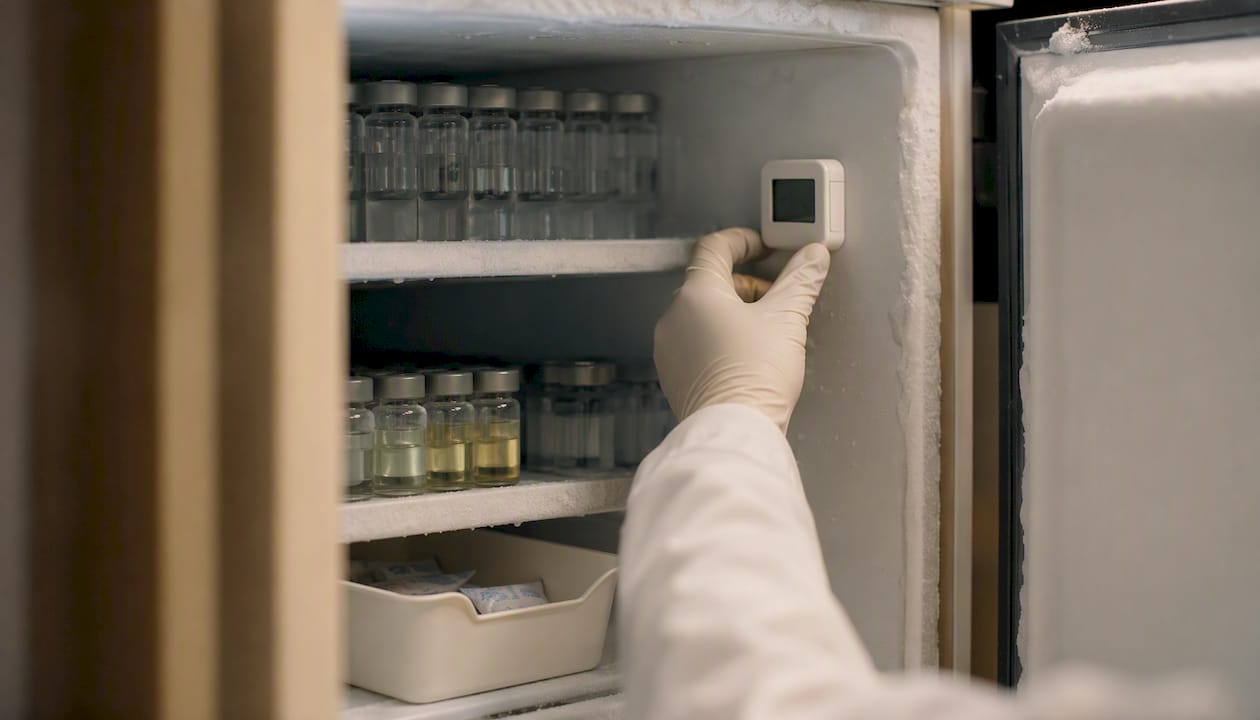
Frost-free (auto-defrost) freezers run periodic heating cycles to prevent ice buildup. Those cycles introduce temperature excursions of 5–10°C or more, which is exactly the thermal cycling that accelerates solid-state degradation. NIBSC explicitly warns against frost-free units for peptide storage. Use a static (manual-defrost) upright or a chest freezer for archival material, and pair it with a calibrated temperature logger and an audible alarm set to trigger at ≥-15°C.
| Storage temperature | Typical stability window | Best suited for |
|---|---|---|
| -20°C | Several years (routine sequences) | Working stocks, stable sequences, short-to-medium term |
| -80°C | Extended duration (sequence-dependent) | Archival lots, oxidation-prone or labile sequences |
| 2–8°C (refrigerator) | Days to weeks only | Temporary holding; not recommended for long-term |
| Room temperature | Hours to days | Transit only; avoid for storage |
Pro Tip: If your sequence contains Met, Cys, or Trp (oxidation-prone) or an Asp-Pro or Asn-Gly junction (hydrolysis-labile), default to -80°C and document the sequence-based rationale in the lot record alongside the COA. That note becomes part of your traceability chain.
How should you handle lyophilized vials before opening them?
The most common source of moisture ingress is not a leaking seal; it is a researcher opening a cold vial directly from the freezer. Condensation forms on the cold glass and powder surface within seconds, and hygroscopic peptides (those rich in Asp, Glu, Lys, Arg, or His) can absorb enough water in that brief window to measurably affect purity over subsequent storage cycles.
Step-by-step pre-opening procedure
- Remove the vial from the freezer and place it, still sealed, inside a desiccator containing fresh indicating silica gel.
- Allow the vial to equilibrate to room temperature inside the desiccator. For a standard 1–5 mg vial, 30–60 minutes is sufficient; larger quantities may need longer.
- Inspect the vial visually before opening: confirm the cake is intact, the color is consistent with the COA description, and the seal is undamaged.
- Open the vial in a clean area, ideally a laminar flow hood or clean bench, to minimize particulate contamination.
- Weigh the required amount quickly using a calibrated analytical balance. Minimize the time the vial is open.
- Reseal immediately with a fresh cap or crimp seal, purge with inert gas if the sequence warrants it, and return to the desiccator before placing back in the freezer.
Labeling and documentation at the vial level
Every vial in your inventory should carry, at minimum: compound name, lot number, COA reference number, date received, storage temperature, and any sequence-specific handling notes (e.g., “Cys-containing, inert atmosphere”). A simple printed label with a QR code linking to the digital lot record works well for high-throughput labs.
For hygroscopic sequences, consider handling the open vial inside a glove bag purged with dry nitrogen if your lab does not have a dedicated dry room. Respirator use (N95 or equivalent) is appropriate when weighing quantities above roughly 50 mg to avoid inhalation of fine peptide dust.
How to reconstitute peptides safely and store aliquots after reconstitution
Reconstitute only what you need for a single experiment, and plan your aliquot volumes before you open the vial. That discipline, more than any solvent choice, is what controls solution-phase stability.
Reconstitution procedure
- Choose your primary solvent based on sequence polarity. Most peptides dissolve readily in water, dilute acetic acid (0.1%), or dilute ammonium bicarbonate (0.1%). Hydrophobic sequences may require an initial dissolution in a small volume of acetonitrile or DMSO (typically 10–20% of final volume) before aqueous dilution.
- Adjust pH toward the stability window. Peer-reviewed degradation studies document that many peptides show the lowest rates of deamidation, Asp cleavage, and oxidation in the pH 4–6 range, though sequence-specific exceptions exist. Highly basic peptides may need a mildly alkaline buffer.
- Add solvent gently and mix by slow vortex or end-over-end rotation. Avoid sonication unless the peptide is confirmed stable under ultrasonic stress; cavitation can shear sensitive sequences.
- If the solution is cloudy after initial mixing, allow 15–30 minutes at room temperature before concluding the peptide is insoluble. Incremental solvent addition often resolves apparent insolubility.
- Filter through a 0.22 µm PVDF or nylon membrane if the solution will be used in a cell-based assay or if particulates are visible.
- Divide immediately into single-use aliquots before freezing.
Aliquoting checklist
- Target concentration: calculate from the weighed mass and confirmed purity (from the COA) rather than nominal mass.
- Vial material: low-binding polypropylene microcentrifuge tubes for most peptides; glass for DMSO-containing solutions.
- Volume per aliquot: size to a single experiment’s requirement so each tube is thawed once and discarded.
- Labeling: compound, lot, concentration, solvent, date prepared, and storage temperature.
- Frozen storage: -20°C for stable sequences in aqueous buffers; -80°C for oxidation-prone sequences or DMSO-containing solutions.
Never refreeze a thawed aliquot. Freeze–thaw cycling promotes aggregation, oxidation, and concentration gradients within the tube, all of which compromise data quality. If you consistently have leftover volume after each experiment, reduce your aliquot size.
How do you recognize peptide degradation before it ruins an experiment?
Visual inspection catches the obvious failures; analytical verification catches everything else. Run both, in that order, before committing a lot to a critical experiment.
Visible and physical signs of instability
- Cake collapse or liquefaction: the lyophilized cake should be a dry, cohesive powder or plug. A collapsed, sticky, or liquid residue indicates moisture ingress and probable degradation.
- Color change: most peptides are white to off-white. Yellow, brown, or pink discoloration suggests oxidation (Trp, Tyr) or Maillard-type reactions from residual sugars in the formulation.
- Unusual solubility: a peptide that previously dissolved readily but now requires extended mixing or leaves visible particulates may have aggregated or partially degraded.
- Increased particulate matter after reconstitution: fine particles that do not dissolve after filtration can indicate aggregated or cross-linked material.
Analytical QC roadmap
Reverse-phase HPLC and mass spectrometry are the primary techniques for confirming peptide identity and purity. Compare your in-house run against the lot-specific COA: the main peak retention time should match within ±0.5 minutes on the same column/gradient, and the purity (area percent) should meet your acceptance criterion for the assay. Mass spectrometry confirms molecular identity and can flag oxidation (+16 Da on Met or Trp), deamidation (+1 Da on Asn or Gln), or hydrolysis products.
Kinetic and stability studies in the peer-reviewed literature document how degradation products accumulate over time, which gives you a framework for setting re-testing intervals based on storage duration and conditions.
Pro Tip: If a lot has been stored longer than its nominal shelf life, or if storage conditions were compromised (a freezer alarm event, for example), run an in-house HPLC check before use rather than relying solely on the original COA. A 20-minute RP-HPLC run is far cheaper than a failed experiment.
Before committing any peptide lot to a critical assay, cross-check three things: the COA purity and identity data, the temperature log for the storage period, and a current visual inspection. If any one of the three raises a flag, run analytical verification before proceeding.
What you need to know about shipping and short-term transport
Lyophilized peptides are more forgiving in transit than reconstituted solutions, but they are not indestructible. The key risk during shipping is not temperature per se; it is moisture ingress from condensation when a cold package enters a warm, humid environment.
On receipt
- Inspect the outer packaging for damage, moisture, or temperature indicator failure before signing for the shipment.
- Check that the COA is present and that the lot number on the vial matches the COA.
- Move vials to cold, desiccated storage immediately if the supplier recommends refrigerated or frozen storage.
- Allow vials to equilibrate in a desiccator before opening, as described above, even if the vials arrived at room temperature.
Shipping checklist for outgoing lots
- Seal vials with a crimp or screw cap and place over desiccant inside a secondary sealed container.
- Use dry ice for shipments requiring -20°C or colder; gel packs for 2–8°C short-duration transport.
- Include a temperature indicator (e.g., a color-change strip) inside the package for critical lots.
- Add oxygen scavengers for oxidation-prone sequences on longer routes.
- Document chain-of-custody: shipper, carrier, tracking number, departure and expected arrival temperatures, and recipient confirmation.
Short-term room-temperature tolerance
A well-dried lyophilizate from a stable sequence can tolerate days to a few weeks at room temperature without significant degradation, provided it remains sealed and dry. That tolerance does not extend to repeated warm–cold cycles. If a shipment was delayed and the package warmed, inspect and re-verify before use rather than assuming the material is intact.
Flag any shipment where the temperature indicator shows excursion, the packaging is wet, or the vial seal is compromised. Quarantine the lot, document the event, and contact the supplier to request COA re-verification or a replacement lot.
Why lot-specific COAs and independent HPLC/MS verification matter for traceability
A Certificate of Analysis is not a formality. It is the primary evidence that the material in the vial matches what the label says, and it is the anchor point for every downstream data interpretation.
Required documentation for each incoming lot
- Lot-specific COA with compound name, molecular formula, molecular weight, and lot number
- Reverse-phase HPLC chromatogram with retention time, purity (area percent), and column/gradient conditions
- Mass spectrometry identity confirmation (observed vs. theoretical mass)
- Analytical method summary (instrument, column, mobile phase, detection wavelength)
- Purity percentage meeting your acceptance criterion (≥99.0% for most research applications)
Sample SOP for incoming peptide lots
| Step | Action | Documentation |
|---|---|---|
| Receipt | Inspect packaging, confirm lot number matches COA | Receiving log entry |
| COA review | Verify purity, mass, HPLC data against acceptance criteria | COA filed in lot record |
| Visual inspection | Check cake integrity, color, seal | Inspection note in lot record |
| Storage logging | Record storage location, temperature, date | Temperature log entry |
| QC acceptance | Sign off or flag for re-verification | QC acceptance form |
Reverse-phase HPLC and mass spectrometry are the standard analytical methods for this verification. Knowing how to read a COA chromatogram, specifically the ratio of the main peak area to total integrated area, is a basic competency for any lab working with research-grade peptides.
Agateresearch supplies every peptide lot with a lot-specific Certificate of Analysis backed by independent reverse-phase HPLC and mass spectrometry verification. Purity is typically ≥99.0% by HPLC, and each COA includes the chromatogram, mass identity, and analytical method details needed to support your lab’s traceability requirements.
Temperature logging is part of traceability, not just good practice. A calibrated data logger inside the freezer, with alarm thresholds set at ≥-15°C for a -20°C unit, creates an auditable record that supports reproducibility reviews and regulatory inspections. NIBSC guidance identifies temperature monitoring as a core component of responsible peptide storage.
The part of peptide storage most labs get wrong
Researchers spend considerable effort choosing the right solvent for reconstitution and almost no effort on freezer selection. That is backwards. A peptide dissolved in the wrong buffer at pH 7.4 will degrade measurably over weeks. The same peptide stored in a frost-free -20°C freezer for two years has been through hundreds of thermal cycles, each one a small degradation event, before it ever reaches the bench.
The other underappreciated failure mode is treating the COA as a one-time check rather than a living reference. Purity at the time of manufacture tells you what you received. It does not tell you what you have now, after 18 months in a freezer that lost power twice. Running an in-house HPLC check before a critical experiment costs less than repeating the experiment.
Agate Research’s lot-specific COA model, with independent HPLC and mass spectrometry data for every lot, gives labs a documented baseline to compare against. That baseline is only useful if the lab maintains the storage conditions and temperature records needed to interpret any deviation from it. The analytical data and the storage log belong together in the lot record.
All compounds supplied by Agateresearch are intended strictly for in-vitro laboratory research use only, not for human or veterinary use.
Agateresearch: research-grade peptides with lot-specific analytical verification
Labs that need verified, traceable peptides for in-vitro research get exactly that from Agateresearch: every lot ships with an independent reverse-phase HPLC chromatogram, mass spectrometry identity confirmation, and a lot-specific COA documenting purity at ≥99.0%. That is not a marketing claim; it is the analytical record that anchors your experimental data.
What that means at the bench:
- Lot-specific COAs with HPLC chromatogram, mass identity, purity percentage, and method details
- Independent HPLC and MS verification for every lot, not batch-level averages
- Full traceability from lot number to analytical data, supporting your lab’s SOP and reproducibility requirements
- Handling and storage guidance available for each compound to support correct reconstitution and freezer conditions
- Research-only supply: all compounds are for in-vitro laboratory use exclusively
View the catalog and request lot documentation at Agateresearch.
Sources
- Peptide storage and handling: lyophilized vs reconstituted, temperature, degradation | Compound Review
- NIBSC - Peptide Storage
- Pubmed
- Pubmed