Formic Acid vs Acetic Acid: Acidity, Structure, Use
Discover the differences between formic acid and acetic acid, including their acidity, structure, and practical applications in chemistry.
Formic acid is the stronger acid. Its aqueous pKa sits at roughly 3.74, against acetic acid’s 4.75, which puts formic acid about ten times higher in dissociated proton concentration at equal molar strength. The gap comes down to one structural fact: formate, the conjugate base of formic acid, carries only a hydrogen atom on its carbon, while acetate carries a methyl group. That methyl group pushes electron density onto the carboxylate oxygens through the positive inductive effect, and a more electron-rich conjugate base is a less stable, higher-energy one. Formate has no such donor, so its negative charge sits closer to the carbon and delocalizes more comfortably across the two oxygens. Less electron crowding, more stable anion, stronger parent acid. That single substitution, one hydrogen versus one methyl, explains most of the pKa gap chemists measure between these two molecules.
Key Takeaways
Formic acid’s lower aqueous pKa (~3.74 versus ~4.75) makes it roughly ten times stronger than acetic acid, a gap driven by the absence of an electron-donating methyl group on its conjugate base.
| Point | Details |
|---|---|
| Acidity verdict | Formic acid (pKa ~3.74) is about ten times stronger than acetic acid (pKa ~4.75) in water. |
| Mechanistic root cause | Acetate’s methyl group donates electron density inductively, destabilizing its conjugate base relative to formate. |
| Reactivity divide | Formic acid reduces and esterifies far faster; acetic acid stays largely inert as a bulk solvent and feedstock. |
| Medium matters | Gas-phase acidity and dimerization behavior shift measured values away from standard aqueous pKa figures. |
| Verification priority | Confirm any lot with RP-HPLC purity, mass spectrometry identity, and a lot-specific COA before use. |
Table of Contents
- Formic Acid vs Acetic Acid: The Numbers Behind the Verdict
- Why Formic Acid Is the Stronger Acid at the Electronic Level
- How Solvent and Dimerization Shift Measured Acidity
- Reactivity Differences That Actually Matter in Practice
- Physical Properties and Handling Hazards Side by Side
- Matching the Acid to the Application
- Verifying Reagent Quality Before It Reaches the Bench
- Sources
Formic Acid vs Acetic Acid: The Numbers Behind the Verdict
Reported pKa figures cluster tightly across reference works, which is reassuring when you are citing them in a methods section. Ullmann’s Encyclopedia lists formic acid’s aqueous pKa at 3.739 and states plainly that it runs about ten times stronger than acetic acid. PubChem’s entry on formic acid (CID 284) backs the same molecular framework, and the NIST Chemistry WebBook supplies the InChI strings and thermophysical anchors researchers use to confirm identity before trusting a reported constant.
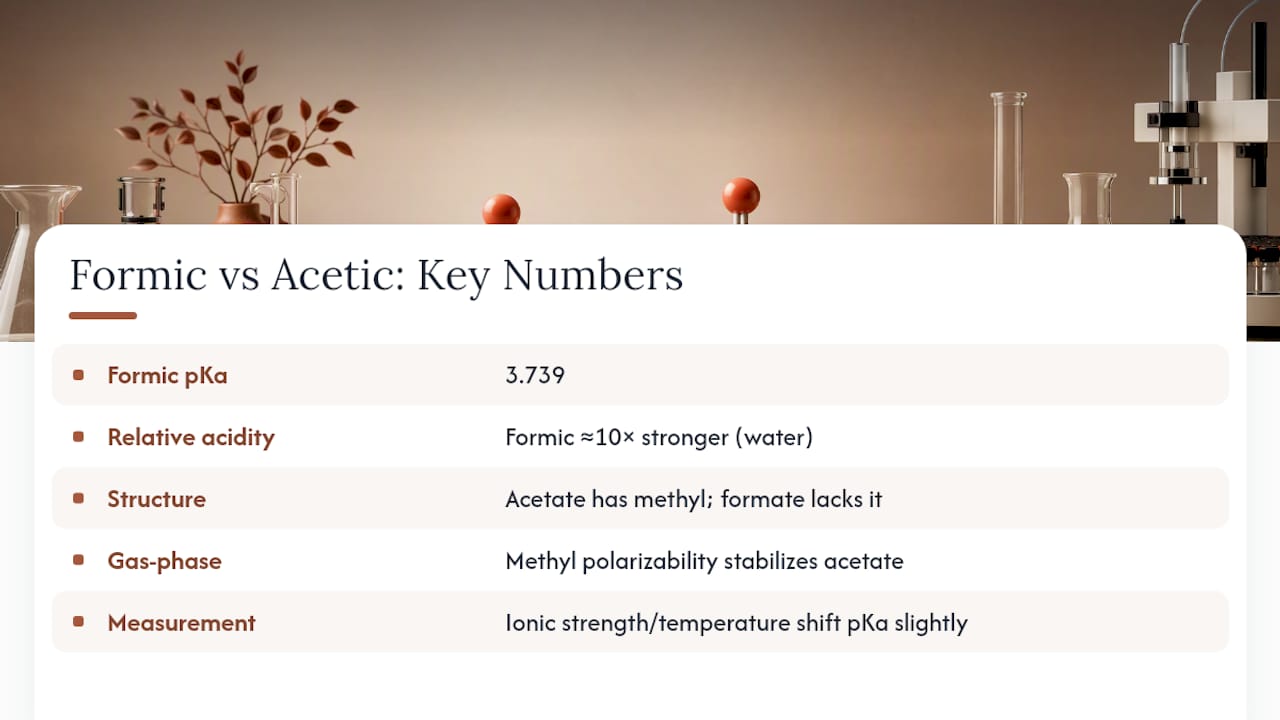
Gas-phase acidity flips some intuitions. In the absence of solvent, acetate’s methyl group can actually offer modest polarizability stabilization that partially offsets its inductive electron donation, narrowing the acidity gap you see in water. This is why gas-phase acidity scales and aqueous pKa tables are not interchangeable. A number pulled from a gas-phase ion cyclotron resonance study will not match a titration curve run in aqueous buffer, and conflating the two is a common citation error in student papers. Ionic strength, temperature, and the reference electrode scale used in the original measurement all shift reported values by a few hundredths to a few tenths of a pKa unit, so when precision matters, go back to the primary dataset rather than a secondary table.
Why Formic Acid Is the Stronger Acid at the Electronic Level
The inductive effect is the headline mechanism, but it helps to walk through it piece by piece if you are trying to build intuition you can apply to other substituted acids.
- Methyl as electron donor: the C-H bonds in acetic acid’s methyl group are weakly hyperconjugating and inductively donating, pushing electron density toward the carboxylate and destabilizing the negative charge on acetate.
- No donor in formate: formic acid’s conjugate base has a single hydrogen on the alpha carbon instead of a methyl group, so there is no comparable electron-donating substituent to crowd the anion.
- Resonance is shared, not decisive: both acetate and formate delocalize their negative charge across two equivalent C-O bonds through resonance, so resonance stabilization is roughly equal between them. It is the inductive difference, not resonance, that separates the two pKa values.
- Hyperconjugation adds a small penalty: the C-H sigma bonds of the methyl group in acetate hyperconjugate weakly with the carboxylate pi system, adding a slight destabilizing contribution to top of the inductive effect.
- Steric and solvation contributions are minor: the methyl group is small enough that classical steric strain plays little role, but it does slightly reduce the anion’s exposed surface for water hydrogen bonding, a secondary factor behind the primary inductive story.
Pro Tip: When you are trying to predict how a new substituent will shift carboxylic acid pKa, ask one question first: is the group at the alpha position electron-withdrawing or electron-donating relative to hydrogen? Electron-withdrawing groups (halogens, nitro groups) stabilize the conjugate base and raise acidity; electron-donating groups (alkyl chains) do the opposite. Formic versus acetic acid is the cleanest textbook case of that rule because the only variable is a single methyl group replacing a single hydrogen.
How Solvent and Dimerization Shift Measured Acidity
Acidity is not a fixed molecular property. It is a measurement made in a specific medium, and the medium does real work.
- Water stabilizes ions well: aqueous solvent surrounds formate and acetate with organized hydrogen-bond shells, and formate’s smaller, more compact charge distribution is stabilized somewhat more effectively, widening the acidity gap you see in standard pKa tables.
- Gas-phase acidity removes that stabilization: without solvent to organize around the anion, intrinsic electronic effects and polarizability dominate, which is part of why gas-phase acidity orderings can diverge from aqueous pKa orderings.
- Both acids dimerize through hydrogen bonding in nonpolar environments: carboxylic acids readily form cyclic, doubly hydrogen-bonded dimers in the vapor phase and in nonpolar solvents, and this association directly affects measured gas-phase acidity and apparent stoichiometry if it is not accounted for.
- Dimer fraction depends on concentration and temperature: dilute aqueous solutions suppress dimer formation almost entirely, while concentrated glacial acid or vapor-phase samples can contain a substantial dimer population, meaning a reported “molarity” does not always equal the monomer concentration doing the acid chemistry.
- Cross-medium comparisons need a caveat: a pKa reported from an ionic-strength-adjusted aqueous buffer study is not directly comparable to a gas-phase proton affinity number, and mixing the two in a single sentence without noting the medium is a common sourcing mistake.
Reactivity Differences That Actually Matter in Practice
Acidity strength is only part of the story. The two molecules diverge sharply in how they behave once you put them to work in a reaction flask.
- Formic acid acts as a reducing agent. Its formyl C-H bond, absent in acetic acid, lets it donate hydride or hydrogen in reactions such as Leuckart-type reductive aminations and select transfer-hydrogenation and dehydrogenation processes, a capability acetic acid simply does not have.
- Esterification runs dramatically faster in formic acid. Ullmann’s reports esterification of alcohols in formic acid proceeding 15,000 to 20,000 times faster than the equivalent reaction in acetic acid, and ChemicalBook notes formic acid can self-catalyze Fischer esterification without any added mineral acid catalyst, a genuine practical shortcut in synthesis.
- Formic acid has two distinct decomposition routes. Dehydration yields carbon monoxide and water; dehydrogenation yields carbon dioxide and hydrogen gas. ChemicalBook notes this decomposition can become autocatalytic in the presence of certain metal impurities, which matters directly for storage vessel selection.
- Acetic acid is comparatively inert as a bulk reagent. It functions mainly as a solvent, acetylating agent precursor, and feedstock rather than as a reactive participant in redox chemistry.
- Latex coagulation favors formic acid industrially. Ullmann’s documents that formic acid gives steadier, more efficient coagulation than acetic acid in rubber latex processing, lowering overall acid consumption per batch.
Physical Properties and Handling Hazards Side by Side
Formic acid and acetic acid look deceptively similar on paper. Both are small, water-miscible, pungent liquids at room temperature, and both show up on nearly every organic chemistry bench at some point. The differences that matter for procurement and storage sit in the details.
- Boiling and melting points differ meaningfully. Formic acid boils around 100.8°C and melts near 8.4°C; acetic acid boils around 117.9°C and melts at 16.6°C, meaning glacial acetic acid can solidify in an unheated storage room in cooler climates while formic acid usually stays liquid.
- Density and odor are both distinctive. Formic acid (density ~1.22 g/mL) has a sharp, penetrating odor even more aggressive than acetic acid’s characteristic vinegar smell, and both vapors are irritating at low airborne concentrations.
- Corrosivity favors caution with both, but formic acid edges out acetic acid on fume hazard. Formic acid vapor is more readily absorbed through skin and respiratory tissue and is associated with more severe burns at comparable exposure, while glacial acetic acid is corrosive to skin and eyes and dilute household concentrations, per Gov, are not expected to cause harm at typical vinegar strengths.
- PPE and ventilation requirements are similar in kind, different in margin. Both acids call for chemical-resistant gloves, splash goggles, and fume hood work above dilute concentrations; formic acid warrants a tighter margin given its more aggressive vapor behavior, and NIOSH exposure guidance and current safety data sheets should be consulted before any bench work with concentrated stock.
- Neither acid tolerates careless storage. Both require corrosion-resistant containers, away from strong oxidizers and, for formic acid specifically, away from conditions that could trigger autocatalytic decomposition.
Matching the Acid to the Application
Choosing between formic and acetic acid in an industrial or lab setting usually comes down to four questions: how strong an acid do you actually need, does the reaction call for reducing character, what does cost and supply chain look like, and how much hazard margin can your process tolerate.
Acetic acid dominates large-scale chemical manufacturing. It is the feedstock for cellulose acetate and vinyl acetate monomer production, and in food contexts it is the additive listed as E260, the acid responsible for vinegar’s characteristic tang at 4 to 18 percent concentration. Formic acid shows up where its extra acid strength or reducing chemistry earns its keep: silage preservation, leather tanning and processing, rubber latex coagulation, and select reduction chemistry that acetic acid cannot perform. Historically, formic acid was recovered as a byproduct of acetic acid manufacture, but dedicated production routes now supply most industrial demand, changing the cost and availability calculus for buyers over the past several decades.
When you are picking a reagent for a specific project, run through this checklist:
- Confirm the acidity requirement. If your reaction needs pH below what acetic acid can deliver at reasonable concentration, formic acid’s lower pKa may be the only practical route without switching to a mineral acid.
- Check whether reducing character is required. If the transformation needs hydride or hydrogen transfer, only formic acid offers that chemistry; acetic acid is a dead end here.
- Weigh cost against consumption volume. Acetic acid is generally the cheaper bulk commodity; formic acid’s premium can be offset if its faster reaction kinetics reduce overall reagent consumption per batch.
- Assess hazard tolerance and ventilation capacity. If your fume hood capacity or PPE protocol is marginal, acetic acid’s somewhat gentler vapor hazard profile may tip the decision.
- Verify purity and traceability needs before ordering. High-precision kinetic or spectroscopic work demands documented purity, not just a bottle labeled “reagent grade.”
Verifying Reagent Quality Before It Reaches the Bench
Neither acid’s pKa value nor its reactivity profile means much in a research setting if the reagent in the bottle is not what the label claims. This is where analytical verification becomes the deciding factor between reproducible data and a retracted result.
- Reverse-phase HPLC establishes purity. A properly run RP-HPLC assay should report purity at or above 99.0 percent, with a chromatogram clean enough to rule out major co-eluting contaminants.
- Mass spectrometry confirms identity, not just presence. A matching molecular ion and fragmentation pattern verifies you actually have formic or acetic acid and not a structurally similar contaminant that a simple titration would miss.
- NMR gives structural confirmation independent of chromatography. A quick ¹H NMR spectrum cross-checks the formyl or methyl proton signature and catches isomeric or hydrate impurities that HPLC alone might not flag.
- Karl Fischer titration quantifies water content. Both acids are hygroscopic enough that water content materially affects both concentration calculations and reaction stoichiometry in anhydrous-sensitive work.
- Acid-base titration provides an independent assay cross-check. Comparing titration-derived concentration against HPLC purity data is a fast internal consistency check before committing a lot to a critical experiment.
A lot-specific Certificate of Analysis ties every one of those results to the exact batch in your hand, not a generic specification sheet for the product line. Reading a COA properly means checking the lot number against the bottle, confirming the assay date is recent enough to be meaningful, and keeping that document on file so any published result traces back to a verified source. This is the standard Agateresearch applies across its research-grade peptide catalog, where every compound ships as an independently verified lot with its own HPLC purity assay, mass-spectrometry identity confirmation, and lot-specific COA, all strictly for in-vitro laboratory research use.
Pro Tip: Build a simple acceptance-testing habit into your intake process: log every incoming lot’s COA data in a shared lab spreadsheet before opening the container, and rerun a spot-check assay on a percentage of incoming lots rather than trusting paperwork alone. That habit catches supplier drift long before it shows up as an unexplained anomaly in your data. All compounds referenced here are intended strictly for in-vitro laboratory research and are not for human or veterinary use.
Sources
- Formic Acid (Ullmann’s Encyclopedia of Industrial Chemistry) - DOI
- Formic Acid | CH2O2 | CID 284 - PubChem
- Gov
- Open-access article on carboxylic acid dimerization (PMC)
Every figure above carries a stated condition, temperature, or medium, and that context matters more than the bare number. Primary literature and current safety data sheets remain the final word before any value gets written into a methods section or a hazard assessment.