COA vs COC: Which Certificate Does Your Lab Actually Need?
Understand the crucial differences between a Certificate of Analysis and a Certificate of Conformance to ensure quality in lab testing.
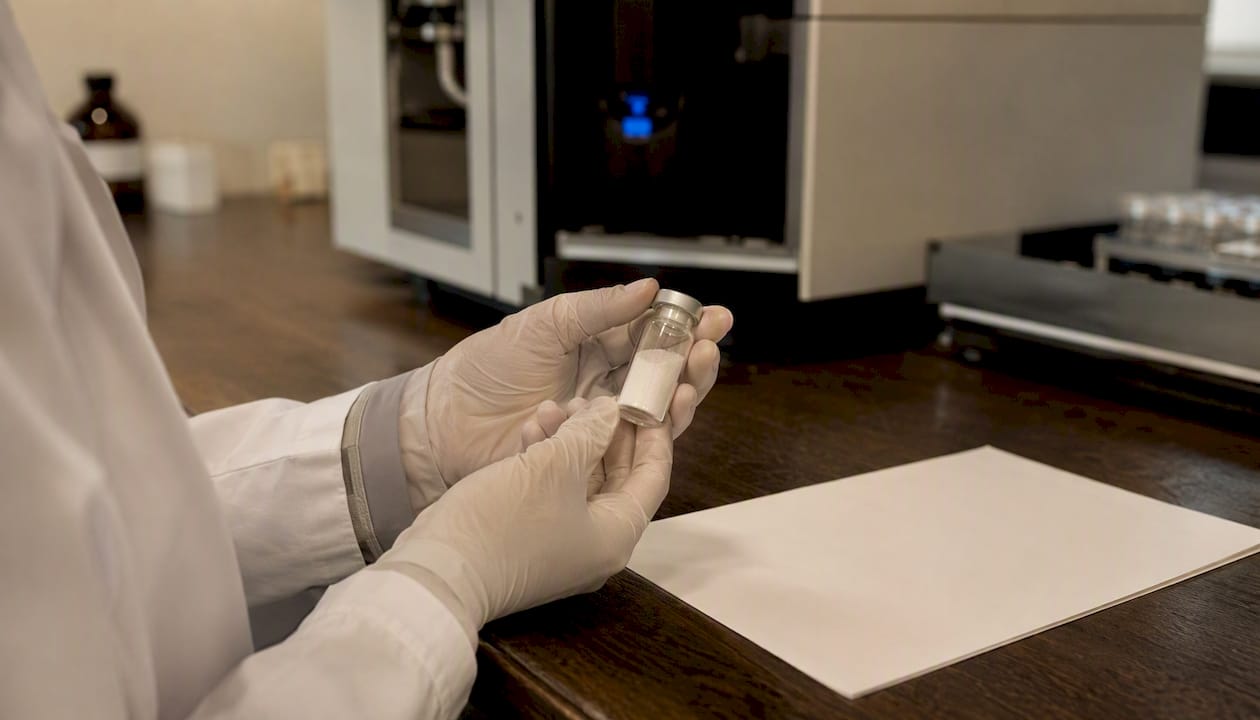
For regulated lab work, request a Certificate of Analysis (COA) every time. A COC tells you a product claims to meet a standard, while a COA shows you the actual test numbers that prove it does.
The distinction matters most at the receiving dock and during audits. Here’s what to do on receipt:
-
Request a lot-specific COA for any API, reference standard, specialty chemical, or batch-critical reagent before accepting the shipment.
-
Accept a COC only for low-risk, non-batch-critical items (standard packaging, commodity consumables) where pass/fail declaration is sufficient.
-
Match the COA lot number to the physical container label before the material enters inventory. No match, no release.
Key Takeaways
A COA provides the batch-level numeric test data required for regulated release decisions; a COC is a conformity declaration that cannot substitute for that evidence in FDA, USP, or cGMP contexts.
| Point | Details |
|---|---|
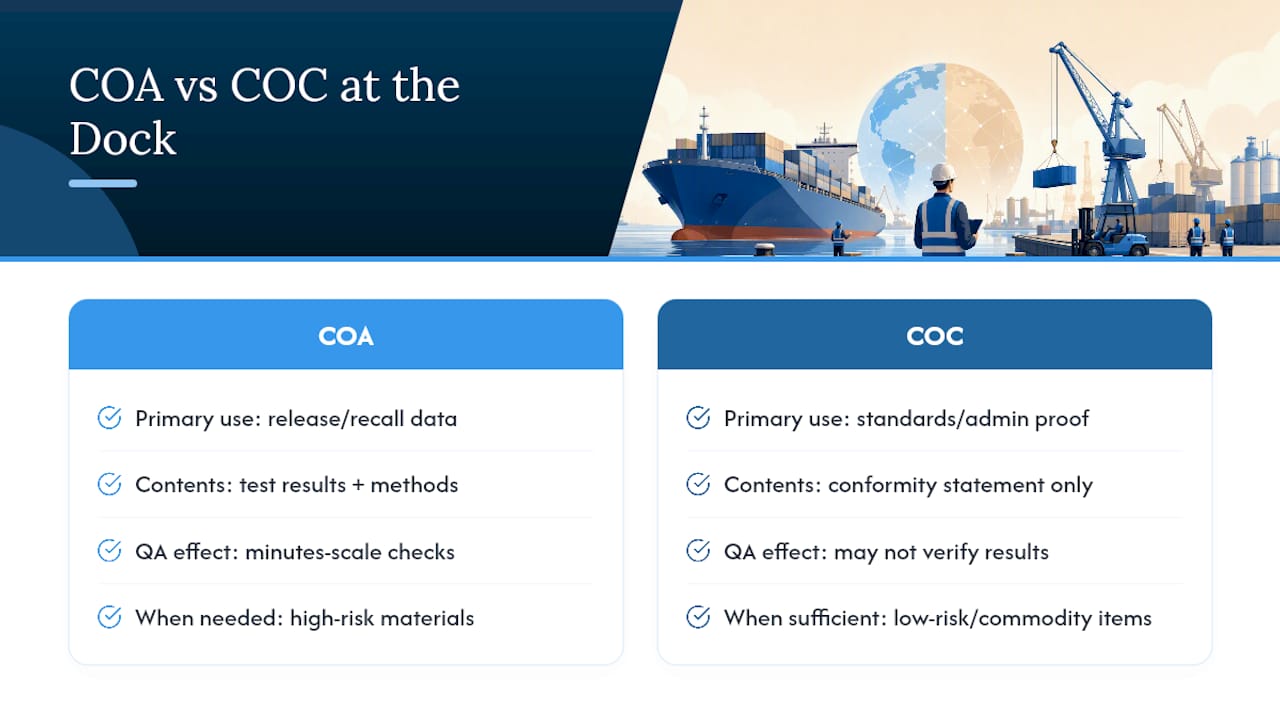
| COA is evidence; COC is a declaration | A COA reports measured results and methods; a COC states conformity without the underlying numbers. |
| Lot-number matching is mandatory | The COA lot number must match the container label exactly before any material enters inventory. |
| Specify COA requirements at the PO stage | Include lot number, methods, numeric results, acceptance criteria, and QA signature in purchase order language. |
| ISO/IEC 17025 accreditation strengthens COA credibility | Accredited-lab COAs carry higher evidentiary weight and reduce receiving verification burden. |
| Agateresearch COAs | Every Agateresearch lot ships with HPLC purity (≥99.0% typical) and MS identity confirmation, lot-specific and method-cited. |
Table of Contents
-
What a Certificate of Compliance contains and when it’s enough
-
Regulatory context in the US: FDA, USP, ISO, and cGMP expectations
-
How Agateresearch issues lot-specific COAs and what buyers receive
-
Agateresearch delivers lot-specific COAs with every peptide order
What is a Certificate of Analysis and how do you read it?
A Certificate of Analysis is a batch-specific document issued by a QA/QC group or accredited testing laboratory. It records the actual measured results for a defined set of analytical tests performed on one specific lot, and it confirms whether those results fall within pre-established acceptance criteria.
Every field on a COA carries meaning:
-
Product name and catalog/CAS number — confirms identity at the document level.
-
Lot or batch number — the single most critical field; links the document to a physical container.
-
Manufacturing and test dates — establishes freshness and retest windows.
-
Test methods — e.g., reverse-phase HPLC for purity, mass spectrometry for molecular identity, Karl Fischer for moisture.
-
Measured results with units — the actual numeric values (e.g., “purity: 99.4% by HPLC”).
-
Acceptance criteria — the specification range each result must fall within (e.g., “NLT 98.0%”).
-
Analyst name and QA signature — confirms the document has been reviewed and authorized.
-
Lab accreditation reference — ISO/IEC 17025 accreditation signals the lab’s measurement competence has been independently verified.
Reading results means more than checking a pass/fail stamp. Look at where the measured value sits within the acceptance range. If any result is out of spec, the material should be placed on hold immediately and an investigation initiated before use.
Pro Tip: Three red flags that should stop a material at receiving: a missing lot number, no analytical method cited for a purity claim, and no QA signature. Any one of these makes the COA unverifiable.
What a Certificate of Compliance contains and when it’s enough
A Certificate of Compliance (also called a Certificate of Conformance, both abbreviated COC) is a supplier or manufacturer declaration. It states that a product meets a referenced standard, specification, or contractual requirement. What it does not include is the underlying numerical test data.
Typical COC fields include product identification, the standard or specification being declared against (e.g., ASTM, ISO, or a customer-defined spec), the authorized representative’s signature, manufacturing date, and sometimes a reference to supporting test reports held on file. The key word is reference: the COC points to evidence without presenting it.
A Certificate of Compliance is a declaration of conformity. A Certificate of Analysis is the evidence behind that declaration. Accepting a COC where a COA is required is the equivalent of accepting a witness statement in place of forensic data. Both have their place — but they are not the same thing, and they are not interchangeable.
COCs work well for customs clearance, standard off-the-shelf components, and commodity materials where the risk profile is low and the specification is binary. They can speed market entry precisely because they are simpler to produce and review. Where they fall short is any situation requiring traceability to a specific batch, numeric purity evidence, or regulatory release decisions.
Side-by-side comparison of COA vs COC across key dimensions
The table below covers the decision-critical dimensions QA teams need when choosing which document to require for a given material or shipment.
| Dimension | Certificate of Analysis (COA) | Certificate of Compliance (COC) |
|---|---|---|
| Purpose | Proves conformity with measured test data | Declares conformity to a standard or spec |
| Issuer | QA/QC lab or accredited third-party lab | Manufacturer or authorized supplier rep |
| Typical contents | Lot number, test methods, numeric results, acceptance criteria, analyst sign-off | Product ID, referenced standard, signature, manufacturing date |
| Level of detail | Numeric results with units and acceptance ranges | Pass/fail declaration only |
| Batch/lot specificity | Tied to one specific lot or batch | Usually product-level, not lot-specific |
| Primary use cases | APIs, reference standards, specialty chemicals, regulated materials | Customs, commodity components, low-risk items |
| Verification and traceability | Lot-number match to container; auditable test data | Declaration only; underlying data held by supplier |
| Turnaround and cost shape | Longer; cost scales with assay complexity | Faster and lower cost to produce |
Common misuses to avoid:
-
Accepting a generic COC for a batch-critical reagent because the supplier didn’t provide a COA. This is the most frequent audit finding in receiving QA.
-
Using a COA from a previous lot to cover a new shipment. Lot numbers change; so do results.
-
Treating a COC as sufficient for an FDA-regulated API release decision. It is not.
The practical impact on QA decisions is direct. A COA with a passing purity result releases the material. An out-of-spec result triggers a hold. A COC alone cannot drive either decision in a regulated context because there are no numbers to evaluate.
Who issues COAs and COCs, and when should you request each?
Issuer map:
-
Manufacturer’s in-house QC lab — most common COA source for commercial chemicals and reagents; acceptable when the lab follows documented methods and the manufacturer has a quality system.
-
Accredited third-party lab (ISO/IEC 17025) — the strongest evidence tier; independent accreditation means the lab’s measurement processes have been externally verified. Request this for high-stakes assays or when regulatory submissions are involved.
-
Manufacturer’s QA department (COC) — the authorized representative signs the conformity declaration; no independent testing required.
Decision checklist for procurement and receiving:
-
At the purchase order stage, specify that a lot-specific COA is required and list the minimum fields (lot number, test methods, numeric results, acceptance criteria, QA signature). Include this language explicitly in the PO — verbal agreements don’t survive audits.
-
At receipt, confirm the COA lot number matches the container label exactly.
-
Verify the test methods are named (not just “by standard method”).
-
Check the lab accreditation status if an independent COA was requested.
-
File the COA with the receiving record before the material moves to storage.
Material-type guidance:
-
APIs and pharmaceutical intermediates: COA required, accredited lab preferred.
-
Peptide reference compounds and specialty research chemicals: COA required with HPLC purity and MS identity.
-
Standard laboratory consumables (pipette tips, bottles): COC is generally sufficient.
-
Packaging materials for regulated products: COC for most; COA if the packaging contacts the product directly and migration testing is required.
-
Food ingredients: both documents are often used together — COA for microbiological and chemical results, COC for labeling conformance.
Regulatory context in the US: FDA, USP, ISO, and cGMP expectations
US regulatory expectations are unambiguous about batch-level evidence. FDA’s Q7A guidance for Active Pharmaceutical Ingredients under cGMP requires manufacturers to test each batch for identity, purity, potency, and contaminants before release. A COC cannot satisfy this requirement. The numeric test data in a COA is the record regulators will ask for.
| Standard / Authority | Scope | COA or COC relevance |
|---|---|---|
| FDA Q7A (cGMP for APIs) | Pharmaceutical APIs and intermediates | COA with batch-level identity, purity, potency, and contaminant data required for release |
| USP General Chapters | Reference standards and compendial testing | COA must cite USP methods where applicable; results must meet USP acceptance criteria |
| ISO/IEC 17025 | Testing and calibration laboratory accreditation | Accredited lab COAs carry higher evidentiary weight; reduces verification burden on receiving QA |
| FDA/CPSC import review | Customs and market entry | COC (or GCC) often accepted for clearance; COA should be retained for post-entry review |
ISO/IEC 17025 accreditation deserves specific attention. When a COA comes from an accredited lab, the lab’s measurement competence has been independently assessed. That reduces the verification burden on your receiving team and strengthens your audit file. For FDA or CPSC inquiries, keep both the COC used for customs and the COA used for release decisions on file. Auditors may request either.
Traceability, lot management, and audit-ready recordkeeping
Lot-number matching is non-negotiable. A COA from a different lot than the one on the container is not a COA for that material. It is a document for a different batch that happens to share a product name. Using it in place of the correct COA breaks the chain of traceability and creates a gap that auditors will find.
Audit record checklist:
-
Store the original COA (PDF or certified copy) linked to the receiving record and the material’s internal lot number.
-
If your lab uses a LIMS or ERP, attach the COA file to the material record at the time of receipt, not retroactively.
-
Retention periods: FDA-regulated labs typically retain batch records for at least one year past the product’s expiry date, or two years past distribution, whichever is longer. Confirm the applicable requirement for your specific product category.
-
Digitize COAs at receipt and maintain a searchable index by lot number. Paper-only filing creates retrieval delays during recalls.
On-arrival verification checklist:
-
Lot number on COA matches lot number on container label.
-
Retest or expiry date is present and not exceeded.
-
QA signature and date are present.
-
Test methods are named, not generic.
-
Results fall within acceptance criteria (no out-of-spec values).
How Agateresearch issues lot-specific COAs and what buyers receive
Agateresearch supplies research-grade peptides as individually verified lots for in-vitro laboratory use. Every lot ships with its own COA, and the analytical methods behind that document are not generic.
Molecular identity is confirmed by mass spectrometry. The COA reports the measured purity value, the MS-confirmed molecular weight, the lot number, test dates, and the acceptance criteria each result was evaluated against. There is no shared or representative COA across lots: each lot is tested independently.
What the Agateresearch COA includes:
-
Lot number tied to the specific shipment.
-
HPLC purity result with acceptance criterion (typically ≥99.0%).
-
Mass spectrometry identity confirmation with observed and theoretical molecular weight.
-
Test method references for both assays.
-
Analyst sign-off and test date.
Buyers can integrate these COAs directly into QA receiving records. The lot number on the COA matches the label on the vial, satisfying the traceability requirement at the first step.
Pro Tip: When a supplier claims an “independent COA,” verify that the issuing lab is named on the document and that a method is cited for every result. A COA that lists purity without naming the analytical method is not independently verifiable.
How to request, obtain, and verify a COA: practical steps
At the purchase order stage:
-
Include explicit COA language in the PO: “Supplier shall provide a lot-specific Certificate of Analysis for each shipment, including lot number, test methods, measured results with units, acceptance criteria, and authorized QA signature.”
-
Specify whether an accredited-lab COA is required (state ISO/IEC 17025 if so).
-
Ask the supplier to confirm turnaround before order placement — HPLC and MS testing has predictable lead times that suppliers can quote, and knowing them prevents receiving delays.
On receipt, verify in this order:
-
Lot number on COA matches container label.
-
All required tests are present (purity, identity, and any additional assays specified in the PO).
-
Methods are named for each result.
-
Results are within acceptance criteria.
-
QA signature and date are present.
-
Lab accreditation is confirmed if an independent COA was required.
Turnaround and cost expectations:
Standard identity and purity testing by HPLC and MS for peptides and specialty chemicals is a well-established workflow. Suppliers with in-house QC can often provide COAs at the time of shipment. Third-party accredited lab testing adds time depending on queue and assay complexity. Simple identity confirmation by MS is faster than a full impurity profile by HPLC with multiple reference standards. When regulatory submissions are involved, build in time for accredited-lab review and any method-validation documentation the submission requires.

Bottom-line recommendation for researchers and QA teams
The choice between a COA and a COC comes down to one question: does this material require numeric evidence of identity and purity, or is a declaration of conformity sufficient?
-
Require a COA for any API, reference compound, specialty chemical, peptide, or batch-critical reagent entering a regulated or research-critical workflow.
-
Accept a COC for commodity consumables, standard packaging, and non-critical materials where a pass/fail declaration against a named standard is sufficient for your risk profile.
-
Require both when customs clearance and regulatory release are separate steps: COC for the border, COA for the lab.
-
Never substitute a COC for a COA in a cGMP, FDA, or USP-governed release decision. The numeric data in a COA is the record; the COC is a declaration that points to it.
Risk management in a regulated lab is built on traceable, verifiable evidence. A COA provides that. A COC alone does not.
A practitioner’s perspective on COA vs COC in daily QA work
The COA/COC distinction sounds straightforward until you’re standing at the receiving dock with a shipment that arrived with only a COC and a production schedule that can’t wait. That’s where the policy decision made months earlier at the PO stage either saves you or costs you.
In routine QA workflows, the COA is the working document. You check the lot number, scan the purity result, confirm the method, and file it. The whole process takes minutes when the COA is complete. When it isn’t, when a lot number is missing or a method is unnamed, the investigation that follows can take days. The near-misses that matter most aren’t the obvious forgeries. They’re the COAs that look fine until you notice the lot number doesn’t match the container, or the purity result is listed without a method, making it unverifiable.
The COC has genuine value in the right context. For customs, for commodity components, for administrative conformity, it does exactly what it’s supposed to do. The problem is scope creep: suppliers sometimes offer a COC when a COA was specified, and receiving staff under time pressure accept it. That’s how a gap enters the audit record.
The practical rule: if you would need the test data to defend a release decision or a recall investigation, you need a COA. If you only need to show a product met a named standard, a COC is sufficient. The risk profile of the material determines which document you require, and that decision should be made at the PO stage, not at the dock.
Agateresearch delivers lot-specific COAs with every peptide order
For research teams that need verified analytical data, not just a declaration, Agateresearch provides lot-specific COAs with every peptide shipment.
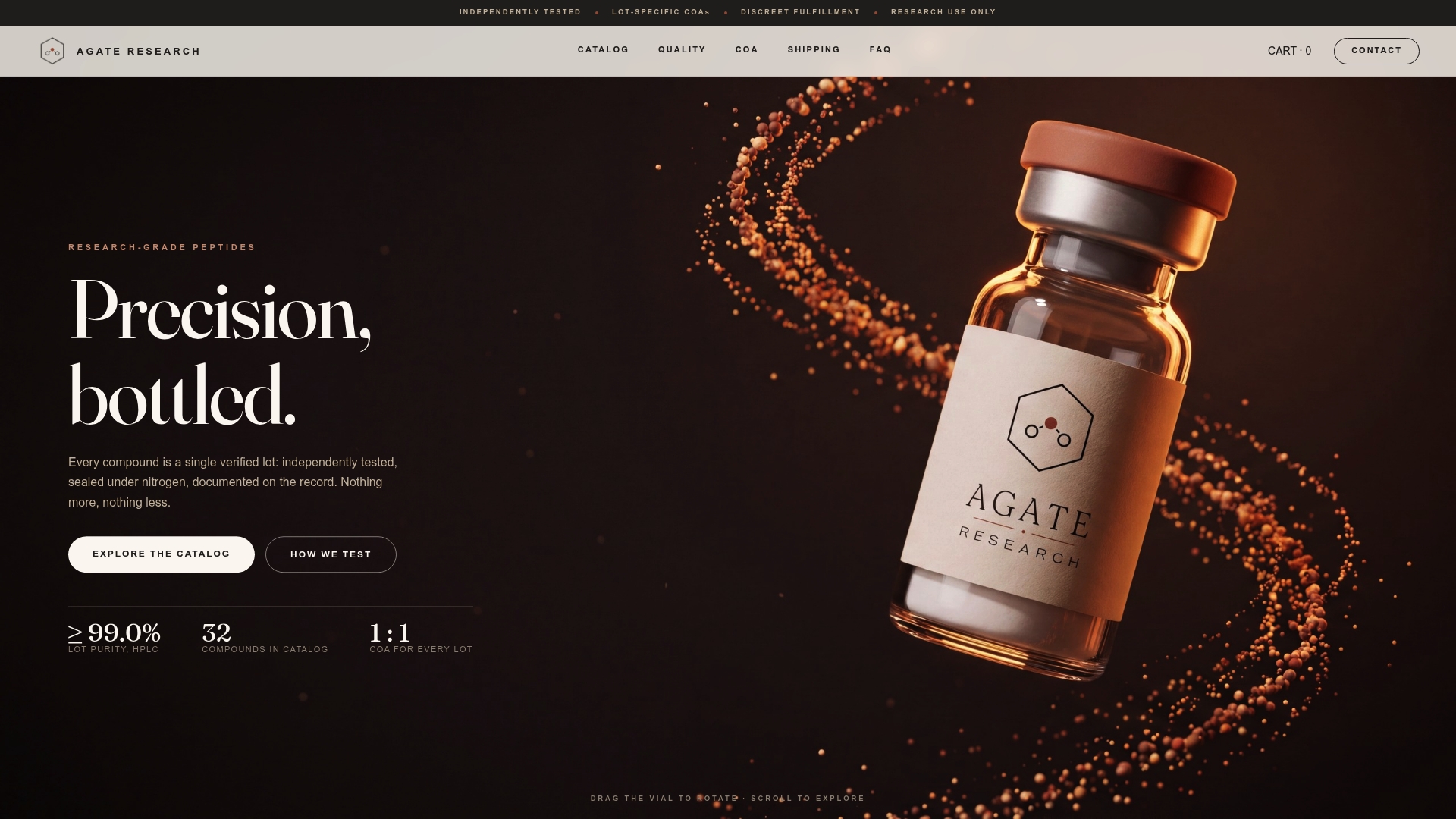
That means your receiving QA team gets a COA that matches the vial label, cites the method behind every result, and integrates directly into your batch records. No chasing suppliers for missing documents, no generic certificates covering multiple lots. If your protocol requires additional testing or accredited-lab documentation, contact Agateresearch before order placement to confirm lead times and available assays.
Browse the catalog and access lot-specific COA data at Agateresearch.
Sources
Recommended
Article generated by BabyLoveGrowth
For laboratory research use only. Not for human or veterinary use.